The Generative AI Music Revolution & Legal Minefield of 2026
The democratization of creative media via artificial intelligence has achieved milestones that seemed unimaginable only five years ago. Perhaps nowhere is this transformation more startling than in music synthesis. Platforms like Suno AI (alongside direct competitors like Udio) have turned music composition into a frictionless conversational experience. By typing a simple natural-language prompt—such as “an upbeat 1980s synth-wave track with driving basslines, melancholic female vocals, and an anthemic chorus about neon rain”—Suno generates a complete, studio-mastered 3-minute song, finished with realistic multi-part vocal harmonies, emotional vibrato, dynamic bridges, and crisp instrumental production, within 45 seconds.
Millions of independent artists, digital content creators, indie video game developers, podcast producers, and advertising agencies now utilize Suno daily to generate background soundtracks, YouTube intros, commercial radio jingles, and full-length musical albums. However, as AI-generated music floods mainstream distribution channels like Spotify, Apple Music, YouTube Music, and TikTok, the surrounding legal, copyright, and commercialization landscape has grown increasingly complex.
Can you legally collect streaming royalties on Spotify from a Suno-generated song? Will YouTube demonetize your video or issue a copyright strike if you use Suno audio in the background of a commercial ad? Who actually owns the underlying sound recording and the musical composition? What happens to your commercial distribution rights if you cancel your paid subscription? In this comprehensive 2026 legal and commercial guide, we dissect Suno AI’s official Terms of Service, explain the critical legal division between Free and Paid subscription tiers, outline digital distributor requirements, and provide a definitive roadmap to safely monetize AI music without risking copyright penalties or platform bans.
The Fundamental Legal Divide: Free Basic Plan vs. Paid Subscriptions
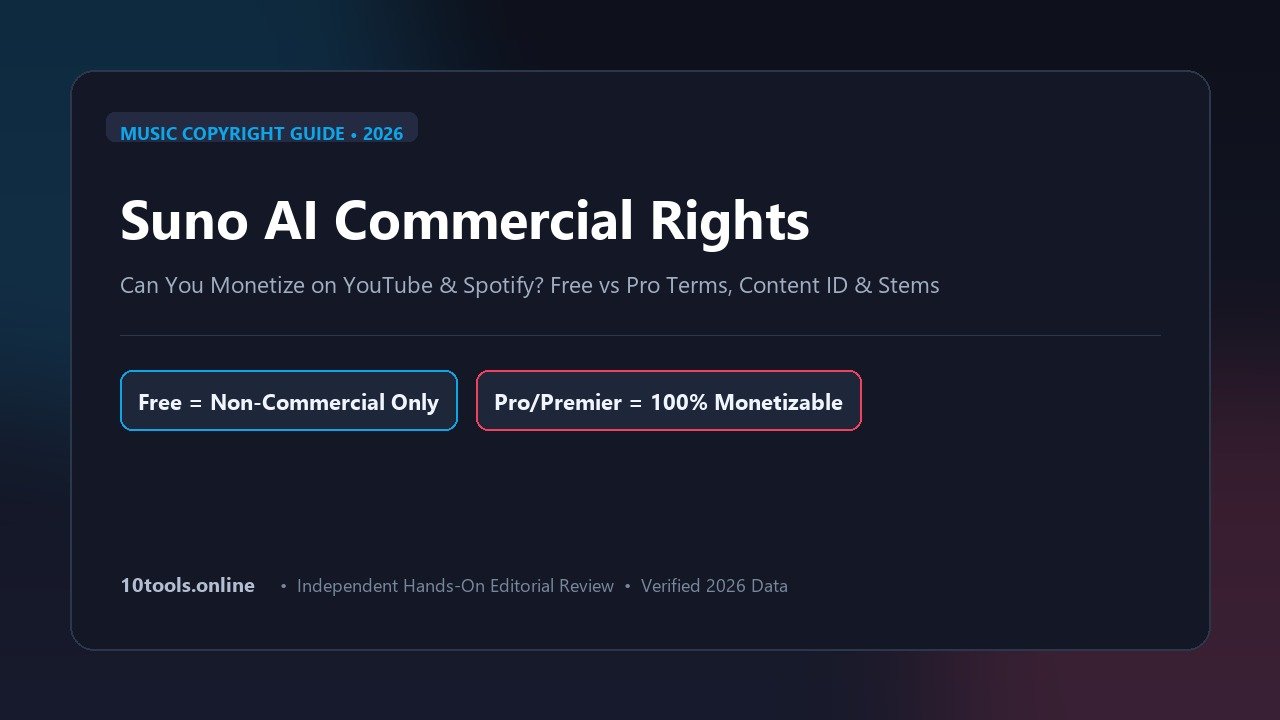
The single most critical concept every creator must understand before publishing or releasing music made with Suno is the strict legal boundary Suno enforces between free accounts and paid tiers. Suno’s Terms of Service establish an absolute, non-negotiable distinction regarding intellectual property ownership:
1. The Free Basic Plan: Suno Retains 100% of Ownership
If you generate songs while using Suno’s Free Basic tier (which provides 50 free credits daily):
- Ownership Status: You do NOT own the songs. Suno Inc. retains 100% of the underlying copyright, ownership rights, and title to all audio files, vocal melodies, and instrumental stems generated under the Free plan.
- Permitted License: Suno grants free users a revocable, non-exclusive, non-commercial license to listen to, share, and enjoy the music strictly for personal, non-commercial purposes.
- Attribution Mandate: Any public sharing of Free-tier songs (such as posting to personal social media or SoundCloud) legally requires explicit attribution stating “Created with Suno” or linking back to the platform.
- Commercial Prohibition: You are strictly forbidden from distributing Free-tier tracks to monetized streaming services (Spotify, Apple Music, Amazon Music), using them in monetized YouTube videos, selling them as stock audio, using them in client marketing campaigns, or licensing them for films or video games. Doing so represents a direct breach of contract and willful copyright infringement.
2. Pro and Premier Paid Plans: You Own the Music
If you generate music while maintaining an active paid subscription (either the Pro Plan at $10/month or the Premier Plan at $30/month):
- Ownership Assignment: Suno officially and contractually assigns full ownership and commercial rights of the generated audio files to you, the paying subscriber. Between you and Suno, you own the sound recordings created during your active paid period.
- Commercial Freedom: You possess the unencumbered legal right to monetize your songs across commercial streaming platforms (Spotify, Apple Music), license them for broadcast television and radio commercials, incorporate them into monetized YouTube videos, sell digital downloads via Bandcamp, and deploy them inside commercial video games.
- Zero Attribution Required: You are under no legal obligation to credit Suno, disclose that AI was used in generation (unless mandated by a specific streaming distributor), or mention the platform in your liner notes.
The “Retroactive Upgrade Trap”: Why Timing Dictates Legality
One of the most dangerous and widespread misconceptions circulating among creators online is what entertainment attorneys call the “Retroactive Trap.”
Imagine this common scenario: A creator signs up for Suno’s Free plan, types a random prompt, and accidentally generates an extraordinary, viral-worthy pop song. Realizing the song has massive hit potential, the creator immediately pulls out their credit card, buys a $10 Pro subscription, and distributes the song to Spotify, assuming that becoming a paid member automatically “buys the commercial rights” to everything in their account library.
Suno’s Official Terms of Service Rule: Upgrading to a paid Pro or Premier subscription does NOT grant retroactive commercial ownership to songs that were originally generated while your account was on the Free plan. Ownership is determined strictly by your account status at the exact second the generation button was clicked.
If you generated a track on the Free plan, that specific audio file belongs to Suno permanently. If you attempt to monetize that specific generation, you are legally unprotected. To legally commercialize that musical concept, you must either re-prompt the song under your active Pro account or recreate the vocal performance using custom audio tools like ElevenLabs for vocal dubbing.
Commercial Rights & Permissions Breakdown Table (2026)
| Commercial Use Case | Free Basic Tier | Pro Tier ($10/mo) | Premier Tier ($30/mo) |
|---|---|---|---|
| Spotify & Apple Music Distribution | ❌ Strictly Prohibited | ✅ 100% Permitted | ✅ 100% Permitted |
| Monetized YouTube Videos (AdSense) | ❌ Prohibited | ✅ Permitted | ✅ Permitted |
| YouTube Content ID Enrollment | ❌ Banned | ❌ Prohibited by Distributors | ❌ Prohibited by Distributors |
| TV, Film & Commercial Sync Licensing | ❌ Prohibited | ✅ Permitted | ✅ Permitted |
| Indie Video Game Soundtracks | ❌ Non-commercial only | ✅ Permitted (Commercial games) | ✅ Permitted (Commercial games) |
| Attribution Required? | ✅ Mandatory (“Created with Suno”) | ❌ None required | ❌ None required |
| Separated Stems & WAV Export | ❌ Standard MP3 only | ✅ Full WAV & Stems | ✅ Full WAV & Stems |
| Post-Cancellation Ownership | N/A (Suno owns) | ✅ Perpetual ownership of past tracks | ✅ Perpetual ownership of past tracks |
Distributing Suno Tracks to Spotify: Distributor Rules
While Suno assigns you commercial ownership under paid tiers, publishing your music to global DSPs (Digital Service Providers like Spotify, Apple Music, and Amazon Music) requires passing through a digital music distributor (such as DistroKid, TuneCore, CD Baby, Symphonic, or Ditto Music). In 2026, distributors have established strict AI governance rules:
- Mandatory AI Metadata Declarations: Spotify and Apple Music now require digital distributors to flag tracks that contain 100% synthetic vocals or AI-generated instrumentals. When uploading through DistroKid or TuneCore, ensure you check the designated box indicating that AI tools were utilized during production. Failing to flag AI content can result in your release being flagged for metadata non-compliance.
- The Complete Ban on YouTube Content ID: Nearly every major digital distributor explicitly prohibits submitting purely AI-generated music to YouTube Content ID. Because foundational AI models can occasionally generate similar melody loops or harmonic progressions for different users, enrolling AI audio into Content ID causes automated bots to falsely flag innocent creators’ videos worldwide. Violating this distributor rule will result in your distribution account being terminated and your royalty balances being frozen.
- Artificial Streaming Purges: Streaming fraud algorithms aggressively monitor newly uploaded AI music for automated bot plays. Never buy promotional “playlist placements” or bot streams; Spotify will permanently remove your catalog and issue financial penalties to your distributor.
The Human-in-the-Loop Advantage: Achieving Real Copyright Protection
One of the most profound legal realities of 2026 is that the United States Copyright Office (USCO) and European Intellectual Property Office (EUIPO) maintain that purely machine-generated content with zero human creative input cannot be copyrighted. While Suno contractually assigns you commercial rights as against Suno, an unaffiliated third party could theoretically copy a raw, unedited AI audio file without violating statutory federal copyright law.
To establish true, defensible statutory copyright over your musical creations, you must introduce substantial human creative authorship into the pipeline:
- Write Your Own Original Lyrics: Rather than letting Suno generate generic AI lyrics, write your own poetic verses and choruses. Your written lyrics represent protected literary copyright.
- Stem Separation & Manual DAW Mastering: Suno Pro allows you to download separated instrumental and vocal stems. Import those stems into a Digital Audio Workstation (DAW) like Ableton Live, FL Studio, or Logic Pro. Add your own acoustic guitar overlays, live synthesizer solos, or customized equalization and mastering.
- Hybrid Vocal Production: Blend Suno backing tracks with real human vocal performances or custom voice synthesis models from ElevenLabs to create unique acoustic arrangements that easily clear copyright registration thresholds.
What Happens If You Cancel Your Suno Subscription?
Another common anxiety among music producers is the fear that canceling a $10/month Pro subscription will invalidate past commercial releases. Suno’s official terms are crystal clear on this issue:
The Perpetual Ownership Rule: You retain full commercial ownership in perpetuity for all tracks generated during active subscription billing cycles. If you generate 50 songs while paying for Pro and subsequently cancel your membership, you continue to own and monetize those 50 songs forever. Any new songs generated after your account drops back to the Free tier will automatically fall under the restrictive, non-commercial Free terms.
Final Editorial Verdict & Practical Action Plan
Generating music with Suno AI offers unprecedented creative power, but commercial success requires strict legal discipline. If your goal is to monetize music on Spotify, release albums, or license soundtracks for commercial clients, you must:
- Always maintain an active Pro ($10/mo) or Premier ($30/mo) subscription prior to generating your target tracks.
- Never distribute songs that were created during Free trial or Free tier periods.
- Opt-out of YouTube Content ID across all music distributors to protect your account standing.
- Archive all monthly billing receipts and generation timestamps as legal proof of paid commercial status.
- Incorporate human lyrical writing and manual post-production mastering to secure strong, defensible copyright protection.
Frequently Asked Questions
Can you legally monetize songs created on Suno's Free plan?
Do you own the commercial rights to songs created on Suno Pro or Premier?
What happens to your music ownership if you cancel your Suno subscription?
Can you enroll Suno AI songs into YouTube Content ID?
Can you upgrade to a paid Pro plan later to commercialize old Free songs?
Can you distribute Suno AI music to Spotify and Apple Music?
Related Guides
Suno AI Commercial Use & Copyright Rules: Monetize on YouTube & Spotify (2026)
Can you legally monetize Suno AI songs on YouTube, Spotify, and commercial ads? We break down Suno's official copyright terms for Free, Pro, and…
Suno AI Commercial Use & Copyright Rules: Monetize on YouTube & Spotify (2026)
Can you legally monetize Suno AI songs on YouTube, Spotify, and commercial ads? We break down Suno's official copyright terms for Free, Pro, and…
n8n vs Make Pricing: Real AI Automation Costs at Scale (2026)
Comparing n8n and Make pricing in 2026. Discover why Make's per-operation billing explodes on AI agent loops, while n8n's execution model and self-hosting save…